What Actually Happens If You Can’t Pay Your HBA EMI
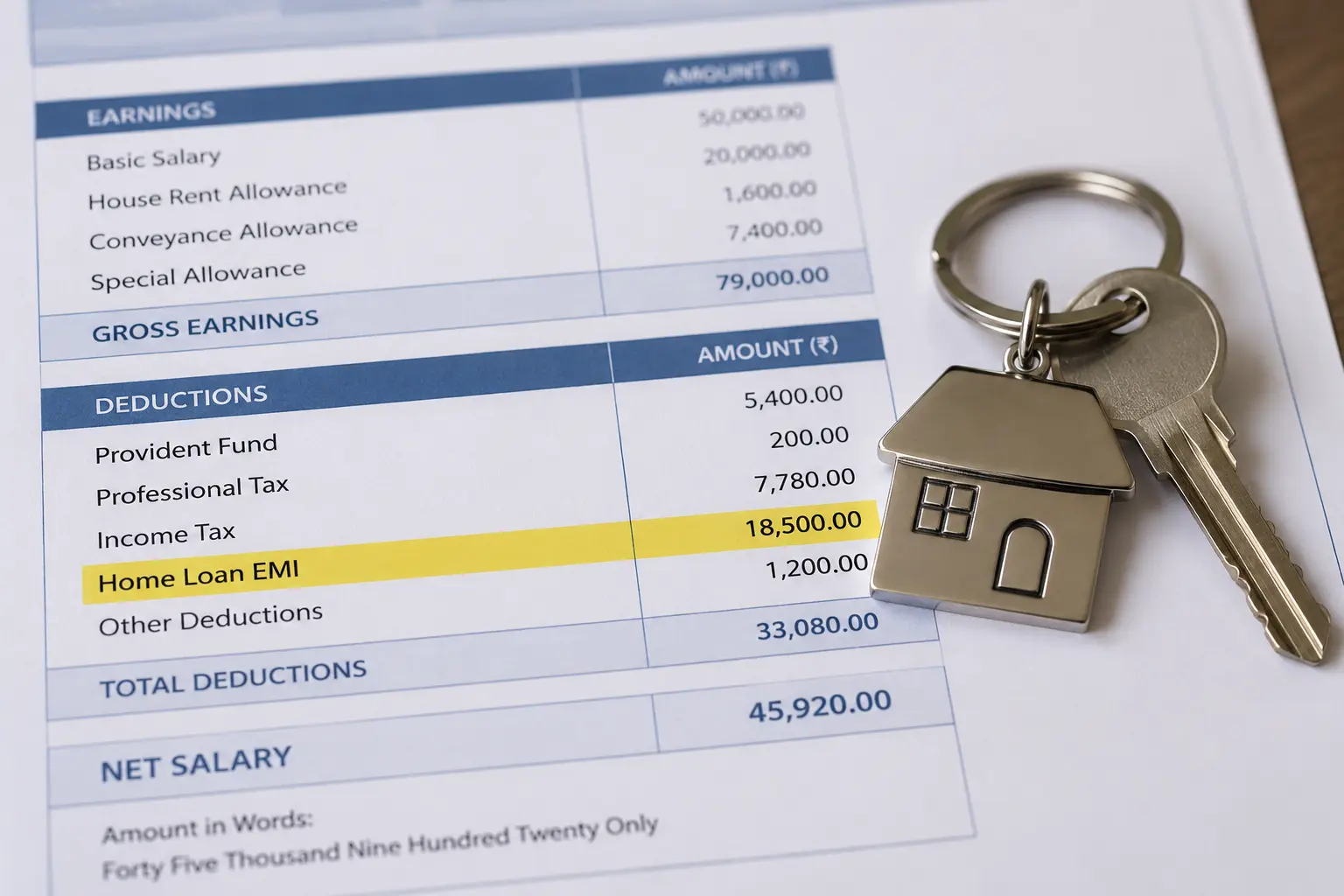
There is no penalty and no late fee, not the way a bank loan default works. Your House Building Advance EMI is deducted directly from your salary by your PSU; you never pay it yourself. If your salary in a given month cannot cover the deduction, the deduction simply does not happen that month, and the amount becomes part of a pending balance.
That balance does not trigger anything while you are still working. It carries forward quietly, growing every month your salary falls short, right up to your retirement. At that point, the outstanding amount is adjusted in one go against your retirement benefits, usually leave encashment first and gratuity after that if the encashment is not enough.
There is another layer to this. Recovery happens in two stages, principal first and interest after. The principal is usually recovered over a fixed number of monthly instalments, the exact number depending on when you took the advance and your organisation’s specific HBA scheme. Interest recovery only starts once the principal is fully cleared, spread over the following several years.
Missed instalments do not get waived at any point. They simply carry forward, which means both stages stretch out longer than planned, and the total interest you end up paying is usually higher than what was calculated when the loan was sanctioned. Some HBA schemes also cap how much can be deducted from your salary each month, often tied to your basic pay and years left to retirement. If your scheme works this way, check your own sanction letter for that cap, since it directly affects how fast dues build up once your pay drops.
The Real Trigger: It’s Usually Attendance, Not the Loan Amount
A bigger HBA does not automatically mean a bigger risk. The real trigger is almost always attendance, not the loan size. Casual leave, earned leave and medical leave all run out eventually, and once they do, the only option left is leave without pay.
LWP means no salary gets credited for those days. If the gap stretches across a month, sometimes longer, there is nothing left to deduct the EMI from. At that point, the loan amount barely matters; an employee with a small HBA and erratic attendance is at greater risk than one with a large HBA and a clean attendance record.
How the Recovery Actually Works at Retirement
Before your retirement benefits are released, your PSU needs to confirm your HBA account is fully settled. This usually means clearing dues and obtaining a No Demand Certificate, the same clearance that is tied to releasing the mortgage on your property. If there is still an outstanding balance at that point, it does not get written off.
The shortfall gets adjusted directly against your terminal benefits. In practice, this commonly means leave encashment is set off first, and gratuity is used only if the encashment amount is not enough to cover the balance. That is exactly what happened in the case I am about to describe.
The exact order is not fixed by one single rule across every PSU; it depends on your sanctioning authority’s directions and your organisation’s specific HBA agreement. Do not assume your case will play out exactly like someone else’s. Check your own sanction letter or housing loan agreement, or ask your HR or accounts section directly, before assuming how recovery will work for you.
A Real Case: ₹15 Lakh HBA, Zero-Attendance Months, ₹6 Lakh Recovered at Retirement
A colleague of mine took an HBA of about 15 lakh, back when that was the typical ceiling, before it was raised to the current 30 lakh limit. This was not a one-off lapse. He was a habitual case, the kind HR keeps a file on. His HOD, the HR head and the pay section each warned him separately that this pattern would cost him at retirement. For a few days after each warning he would show up regularly, then the cycle would repeat, attendance dropping again within weeks.
For several months his attendance dropped to zero. His casual leave, earned leave and medical leave were all exhausted, so those absences were marked as leave without pay.
With no salary credited for those months, there was nothing to deduct the EMI from. The dues simply carried forward month after month, exactly the way the rules work on paper, quietly growing in the background. He never raised it as a concern, and even after retirement he still had not fully registered what had happened to his account.
By the time he retired, the outstanding amount had built up to around 6 lakh. It was adjusted first against his leave encashment, and the remainder was recovered from his gratuity. He never faced anything that looked like a loan default; he simply walked away from retirement with far less than he expected.
What Happens to Your HBA If You Die Before It’s Repaid
This is the one scenario that does not leave your family exposed. When you take an HBA, you are required to assign a life insurance policy covering the advance amount in favour of the government, and keep it active until the loan is fully repaid. If you die in service, or even after retirement with the loan still outstanding, the insurance proceeds are used to clear the remaining balance.
This works differently from the default scenario we have been discussing. A salary disruption from leave without pay leaves a shortfall that eventually hits your retirement benefits. Death in service does not work the same way, because the insurance assignment exists specifically to prevent that outcome. Your family is not expected to repay what you owe, and the mortgaged property is released to your legal heirs once the insurer settles the claim.
How to Check If You’re at Risk Right Now
You do not need to wait for a crisis to find out where you stand. A few checks with your accounts or HR section will tell you exactly how exposed you are.
- How many days of casual, earned and medical leave do you have left this year, and how fast are you using them?
- What is your current HBA outstanding balance, principal and interest combined? Your accounts section can give you this on request.
- What share of your monthly salary does the EMI take up? If your salary dropped to zero for even one month, would the deduction still go through?
- Does your sanction letter or HBA agreement say what happens at retirement if there is a shortfall, leave encashment first or gratuity first?
- Is your house insurance for the HBA still active and renewed every year? If it lapses, you are charged a penal interest of around 2 percent over your normal HBA rate for the uncovered period, on top of everything else.
If your leave balance is thin and the EMI eats up a large share of your salary, you are closer to the kind of situation my colleague ended up in than you might think.
What to Do If Your Attendance or Pay Is Already Slipping
If your leave balance is already running thin, the worst thing you can do is what my colleague did: nothing. Talk to your accounts or HR section as soon as leave without pay starts becoming a pattern, not after it has gone on for months.
Ask specifically whether you can deposit the EMI amount yourself through a challan or demand draft during a no-pay month, instead of letting it sit as arrears. Many PSUs allow this even though it is rarely advertised, and you only find out by asking. If the attendance issue is medical, get it documented and regularized wherever possible, since unresolved LWP almost always turns into permanent arrears rather than something that gets reversed later.
Most importantly, do not wait for retirement to find out your outstanding balance. Request a written statement of your HBA dues from your accounts section once a year, especially in any year your attendance has been irregular. That single habit would have shown my colleague exactly what was building up, years before it cost him 6 lakh out of his retirement benefits.