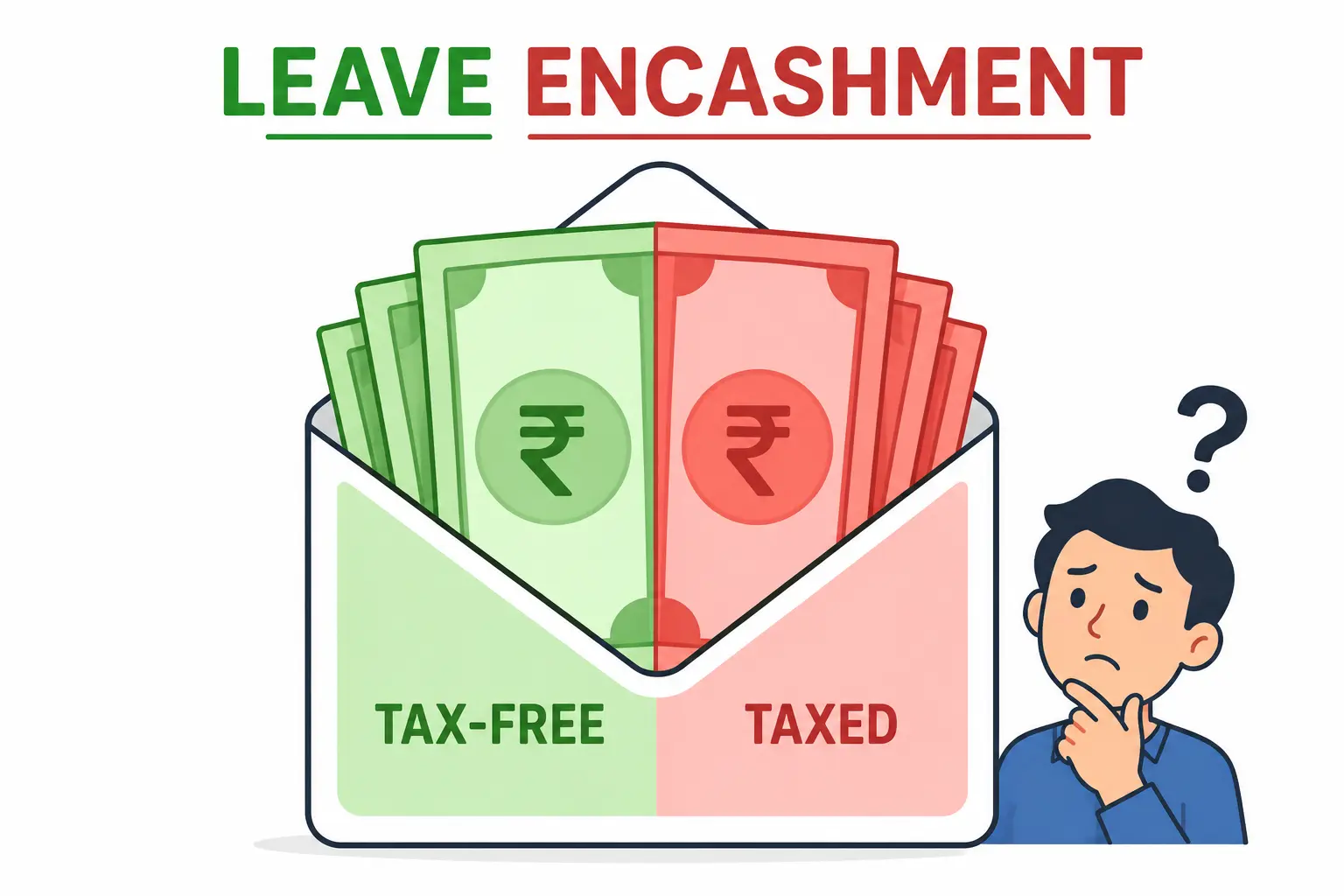
Why PSU Employees Assume Leave Encashment Is Always Tax-Free
A lot of PSU employees treat leave encashment like a quiet bonus, money the company hands you that somehow stays off the tax department’s radar. I hear this most from new joinees who haven’t sat through a payslip with TDS deducted on an encashment payment yet. But it’s not only them. I’ve had a few employees close to retirement say the same thing, assuming that because the money comes at the end of service, it must be automatically tax-free.
Neither version is right. Leave encashment is salary income the moment your employer pays it, full stop. It shows up in your Form 26AS and AIS exactly like your basic pay and DA do. The tax department isn’t missing this payment; it’s sitting right there in your tax record for the same financial year you receive it.
What actually varies is not whether it gets taxed, but how much of it gets exempted, and that depends entirely on one thing: are you encashing leave while still working, or are you encashing it at retirement or resignation. Those are two completely different tax events, and treating them as the same thing is where most of the confusion starts.
Two Different Events, Two Different Rules
The law doesn’t see “leave encashment” as one thing. It sees two separate events, and each one sits under a completely different section of the Income Tax Act.
The first is encashing leave while you’re still in service, the annual carry-forward payout some PSUs offer, or any interim cash-out you take before you retire. The second is encashing your full leave balance at the time you leave the organisation, whether that’s retirement, resignation, VRS, or even payment to your family after death.
The first kind falls under Section 17(1) and gets treated exactly like your salary. No special exemption, no calculation, nothing to claim. The second kind falls under Section 10(10AA), and this is where the exemption math actually applies.
This is exactly where the confusion I mentioned earlier comes from. Someone hears that a retiring colleague got their entire encashment tax-free, then assumes the same protection covers the leave they cashed out two years into the job. It doesn’t. Different event, different rule, and no overlap between the two.
Encashing Leave During Service: Fully Taxable, No Exemption
If you encash leave while you’re still working, the entire amount goes straight into your salary income for that financial year. There’s no special calculation, no four-way test, no carve-out under Section 10(10AA). It’s taxed exactly the way your basic pay or DA arrears would be, at whatever slab rate applies to your total income that year, with TDS deducted under Section 192.
This is the part most colleagues get wrong. They assume that because leave encashment “feels” different from regular salary, it must be taxed differently too. It isn’t. The Income Tax Act doesn’t care what the payment is called; it cares which section it falls under, and in-service encashment falls under plain old Section 17(1), same as your pay.
What you can actually control is the amount and the timing, not the tax treatment. Here’s what I do: before I encash any leave in a given year, I work out the gap between my current gross salary and the next tax slab boundary, and I only encash up to that gap, never beyond it.
The idea isn’t to make the encashment tax-free, because it never is. It’s to stop the extra income from pushing my total taxable income into a higher slab and raising the rate on everything above that line.
This is slab management, not exemption-seeking, and it depends entirely on your own salary, deductions, and how close you already are to a slab boundary in that particular year. It won’t help someone whose salary already sits in the top slab regardless of what they encash. If you’d rather not run this math yourself every year, ask whoever handles your IT projections at the start of the financial year; payroll usually has the numbers already.
One more thing worth knowing: if a large chunk of accumulated leave gets encashed in one go and pushes you into a higher bracket, Section 89 relief through Form 10E can sometimes soften that bunching effect. It’s a separate provision from anything discussed above, but worth checking with a tax professional if your encashment amount is large.
Encashing Leave at Retirement: The Real Section 10(10AA) Rules
At retirement, resignation, or superannuation, the exemption actually exists, but it’s not unconditional. The law works out four separate figures and exempts whichever is the smallest of the four. Everything above that smallest figure gets added to your taxable salary for the year.
The four figures are:
- The actual leave encashment amount you receive.
- Ten months’ average salary, calculated on your basic pay plus DA for the ten months immediately before retirement.
- The cash equivalent of your unused leave, capped at 30 days of leave for every completed year of service, even if your organisation lets you accumulate more.
- The statutory ceiling of ₹25 lakh, a lifetime cap across your entire career, not per job or per retirement. This ₹25 lakh figure applies to encashment received on or after 1 April 2023. If you retired before that date, the older ₹3 lakh cap was what applied at the time.”
Whichever of these four is the lowest is what you get exempt. The rest is taxed at your normal slab rate.
Here’s the part that trips up a lot of PSU employees: this is the non-government rule, under Section 10(10AA)(ii). Only Central Government, State Government, and local authority employees get full, uncapped exemption under Section 10(10AA)(i). PSUs, even fully government-owned ones, don’t fall under that clause. You’re treated the same as a private-sector employee here, no matter how “government” your organisation feels day to day.
One more detail that matters for the salary figure: only basic pay and the portion of DA that counts toward retirement benefits get used in the calculation. HRA, medical allowance, LTA, and other components don’t enter this math at all.
And the ₹25 lakh limit isn’t reset if you change employers. If you’ve already claimed part of this exemption from an earlier employer, whatever’s left of the ₹25 lakh is what’s available to you now, not a fresh ₹25 lakh.
A Real Case: How a Colleague’s Full Leave Encashment Came Out Tax-Free
A colleague I handled the retirement paperwork for recently is a clean example of how this calculation actually plays out, not because anything was done specially for him, but because the four-way test simply landed in his favour.
He retired after more than 35 years of service, with his organisation’s full leave encashment cap of 300 days standing to his credit. His basic pay plus DA at retirement was around ₹1.3 lakh.
Run the four figures:
- Actual amount received: roughly ₹13 lakh, calculated at his daily basic+DA rate for 300 days.
- Ten months’ average salary: also around ₹13 lakh.
- Cash equivalent of leave at credit, capped at 30 days per year of service: with 35 years behind him, the law would have allowed credit for up to 1,050 days. He only had 300, so this test landed at the same ₹13 lakh too.
- The statutory ceiling: ₹25 lakh.
Three of the four figures came out at roughly the same amount, and all three sat comfortably below the ₹25 lakh ceiling. The lowest of the four is what gets exempted, and here, the lowest figure happened to equal the actual amount he received. Result: his entire leave encashment came out tax-free, correctly, with nothing left over to be taxed.
This isn’t a special outcome reserved for long service. It worked out this way because his salary level and leave balance, run through the formula, simply didn’t cross any of the lower three thresholds. Someone with a higher basic+DA, a longer accumulated leave balance, or one who’d already used up part of the ₹25 lakh lifetime cap with a previous employer could see a very different result, with part of their encashment taxed even at retirement.
Leave encashment is calculated separately from gratuity, though both usually get settled in the same retirement paperwork.
What to Check Before You Encash, During Service or at Retirement
Whether you’re cashing out leave mid-career or finalising your retirement papers, the mistakes I see aren’t usually about the law itself. They’re about employees not checking the numbers before signing off, and finding out the hard way once the TDS or the exemption calculation is already locked in.
If you’re encashing during service, here’s what actually matters. Know upfront that the whole amount is taxable; there’s no version of in-service encashment that escapes tax. Work out your current year’s taxable income before you decide how much to encash, not after, and see how close you already are to the next slab boundary.
If the timing is flexible, encashing in a year where your income is naturally lower, say during a sabbatical or a year with fewer increments, costs you less than encashing in a year where you’re already near a slab edge. And if you do end up with a large bunched amount in one go, ask your tax preparer whether Section 89 relief through Form 10E applies before you file your return. It sometimes does, and it’s easy to miss if nobody mentions it.
At retirement, the checklist looks different, and the stakes are higher because you don’t get a second attempt. Get the exact leave-encashment policy of your specific PSU in writing, not a general idea of it. The 300-day cap I mentioned earlier in my colleague’s case is his organisation’s rule, not a universal one; some PSUs cap lower, some structure it differently.
Ask accounts for the actual figures used in all four parts of the exemption calculation, the amount received, the ten-month average, the leave-credit equivalent, and the remaining balance of your ₹25 lakh lifetime cap, before you sign your final settlement. Your PF withdrawal and EPS pension settlement get checked separately from this, but it’s worth verifying both in the same sitting.
If you’ve worked for more than one employer and already claimed any part of this exemption earlier in your career, disclose it. The ₹25 lakh ceiling is cumulative across your whole working life, and an incomplete disclosure here is exactly the kind of thing that surfaces later as a mismatch in your AIS, not something you want to discover after you’ve already filed your ITR for that year. And don’t assume your PSU counts as “government” for this section. It almost certainly doesn’t. If your payroll or accounts section tells you otherwise without pointing to which clause of Section 10(10AA) they’re applying, ask them to show you, in writing, before you rely on it.
When you file your ITR for the year you receive retirement dues, report the leave encashment under “Income from Salary” and claim the exemption under the specific Section 10(10AA) schedule, not as an exempt allowance lumped in with something else. Employers sometimes show the exempt portion correctly in Form 16, but check it against your own four-figure calculation before you accept what’s printed there. A mismatch between what your employer reported and what the law actually allows is the kind of thing that gets flagged years later, long after you’ve stopped keeping track of that year’s papers.
Before you encash anything, in service or at retirement, ask for the calculation in writing. A number on a payslip or a final settlement letter without the four-figure test behind it isn’t proof you got the right exemption. It’s just a number someone typed.