Ex-Gratia and Productivity Linked Bonus Are Not the Same Scheme
If you’ve ever heard a colleague say “PLB” while describing what your PSU actually pays as ex-gratia, here’s the simplest way to catch the mistake: ask whether everyone got the same rate. If the answer is yes, it can’t be PLB.
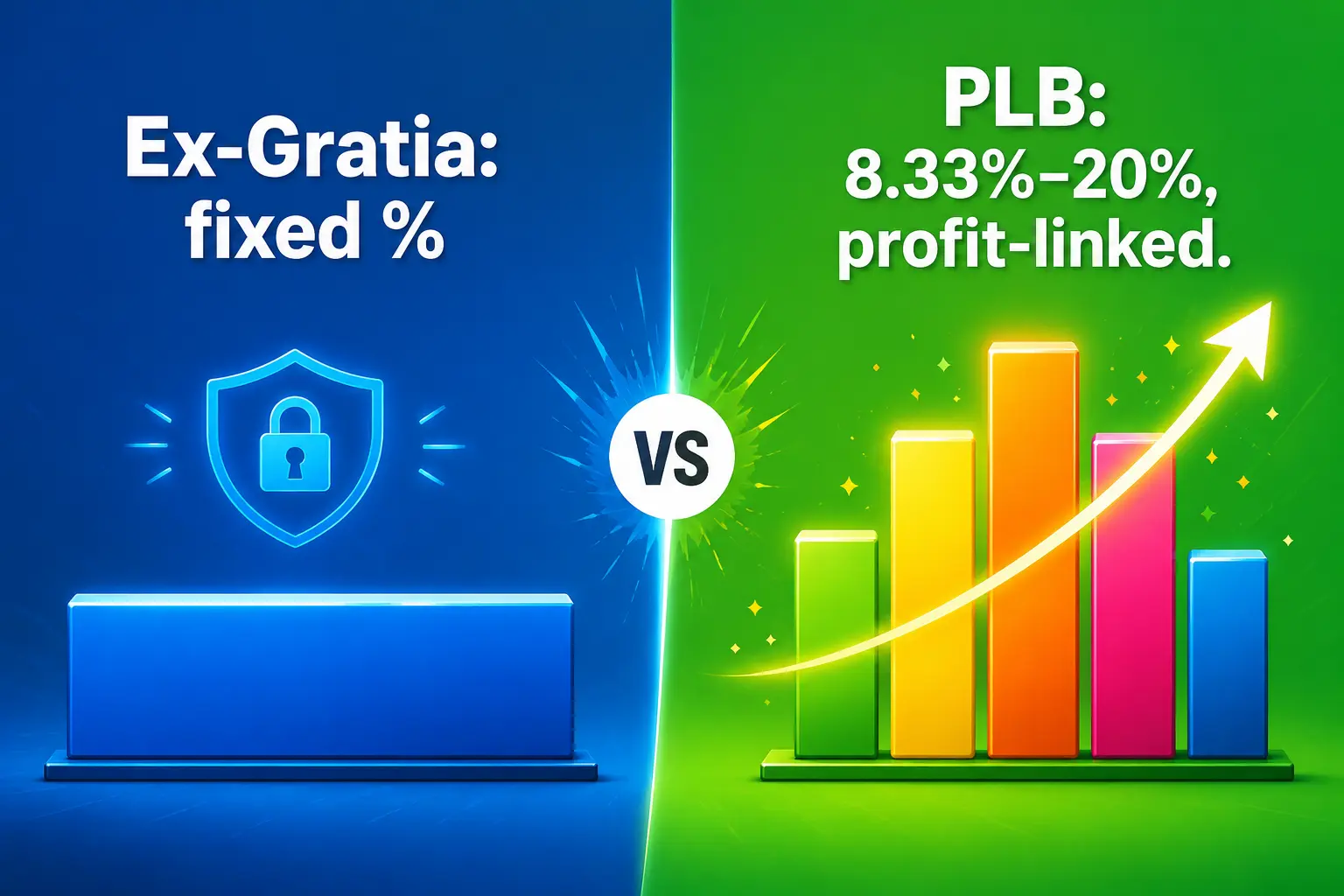
Productivity Linked Bonus is, by definition, tied to performance. It depends on whether your PSU signed an MoU with the government, met its targets, and turned a profit that year. The percentage can move up or down depending on how the organisation did, and in a good year it can go well past the statutory floor.
Ex-gratia bonus works the opposite way. It’s a fixed payout, decided in advance, that doesn’t change whether your department had its best year or its worst. PSUs that don’t qualify for PLB, whether because they’re not profit-making or haven’t signed an MoU, still pay something before the festive season, and that something is ex-gratia.
The flat 8.33% you and every colleague get, regardless of who hit targets and who didn’t, is the giveaway. The rupee amount differs only because basic pay differs by grade and seniority, not because the rate itself changes. That’s not your PSU using a confusing label. That’s your PSU correctly telling you it doesn’t run a PLB scheme.
The Legal Floor Behind Both: 8.33%–20%, and What Changed in November 2025
Whether a PSU pays PLB or ex-gratia, both sit on top of the same statutory floor. The law requires a minimum bonus of 8.33% of an employee’s basic pay plus dearness allowance, with a ceiling of 20% if profits allow. The calculation itself is capped: even if your basic plus DA crosses ₹7,000 a month, the bonus is worked out as if it were exactly ₹7,000 (or the applicable minimum wage, if that’s higher). Employees drawing basic plus DA above ₹21,000 a month fall outside this statutory floor altogether, though many PSUs still pay them something through their own policy.
For sixty years, this came from the Payment of Bonus Act, 1965. That changed on 21 November 2025, when the central government repealed the Act along with three other wage-related laws and replaced them with the Code on Wages, 2019. If you’ve seen “Payment of Bonus Act” cited anywhere recently, including in older PSU circulars, it’s now technically the wrong reference.
As of this writing, the change hasn’t altered much in practice. The Code on Wages has come into force, but the specific rules covering bonus calculation under it haven’t been separately notified yet. Until they are, the old thresholds, 8.33% to 20%, the ₹7,000 calculation cap, the ₹21,000 eligibility limit, continue to apply through the law’s savings clause. That could shift once the new rules are finalised, so treat this as the current position, not a permanent one.
None of this is what actually puts money in your account, though. PSUs don’t pay bonus straight off this law. They follow yearly guidelines from the Department of Public Enterprises, which borrow the same percentage range but decide separately which PSUs qualify for PLB and which get ex-gratia instead. That’s the next part.
How Your Org’s Ex-Gratia Actually Works — Flat 8.33% on Basic Pay Alone
Your organisation calculates this on basic pay alone, not basic plus DA. That’s worth sitting with for a second, because the statutory formula in the previous section uses basic plus DA as the base. Your PSU has chosen a narrower base, and the result is a smaller payout than the textbook formula would produce for the same basic pay.
The rate itself doesn’t move. Whether you’re a fresh recruit or someone twenty years in, the percentage is the same 8.33%. The only thing that changes the rupee figure is your basic pay itself, which goes up with grade and increments. So when a senior colleague gets a bigger cheque than a junior one, it’s the basic pay doing the work, not a better rate for seniority.
The amount is worked out from the previous financial year and paid as a single lump sum, not spread across monthly pay. That’s standard practice across PSUs that pay ex-gratia or PLB, so nothing unusual there.
What is worth flagging: don’t assume every PSU calculates on basic alone. Some follow the standard basic-plus-DA base from the statutory formula. If you’re comparing notes with a friend at a different PSU, the base salary used for the calculation is one more thing that can differ, on top of the rate and the scheme name. Your own organisation’s payroll order or circular will state which base it uses, so that’s the document to check before you assume someone else’s PSU is “better.”
Why Some PSUs Pay More: Profit, MoU Rating, and Productivity Linkage
A PSU becomes eligible for PLB instead of ex-gratia mainly by being profit-making and having signed an MoU (Memorandum of Understanding) with its administrative ministry that year. The MoU sets performance targets, and at year-end the PSU gets rated against them, typically on a scale from Excellent down to Poor. A higher rating combined with healthy profits is what allows a PSU to pay above the statutory 8.33% floor, sometimes up to the 20% ceiling.
This is exactly why your friend’s PSU can land a bigger payout than yours in the same year. It isn’t favouritism or a “better” employer. It’s a different PSU, with a different MoU, a different profit position, and a different DPE-approved ceiling for that year. The actual rupee ceiling per employee and the exact slab structure are decided fresh by DPE guidelines each year and vary from one PSU to another, so there’s no single number that applies across the board.
A loss-making PSU, or one that hasn’t signed an MoU, doesn’t get to participate in this upside even if individual employees worked just as hard. That PSU falls back to ex-gratia, which is fixed regardless of how the year went. So the real divide isn’t “PLB PSUs work harder.” It’s “PLB PSUs are structured, that year, to share profit with employees in a way loss-making or non-MoU PSUs aren’t.”
If you want to know exactly where your PSU sits, the DPE circular or office memorandum your HR/finance department receives each year before payout will say plainly whether you’re classified for PLB or ex-gratia that year, and that classification can technically change if your PSU’s profit or MoU status changes.
Why It Lands Before Durga Puja, Not at Financial Year-End
The law gives a clear outer limit: bonus must be paid within eight months of the end of the financial year. Since the financial year closes on 31 March, that pushes the deadline out to roughly the end of November. Durga Puja and Diwali both fall comfortably inside that window, which is why PSUs and the central government time the payout to land before the festival rather than at financial year-end itself.
The lag isn’t bureaucratic delay for its own sake. The bonus for a financial year can only be worked out once that year’s profit and performance numbers are final, and those numbers aren’t ready the day the year closes. DPE then has to issue its annual guidelines confirming which PSUs qualify for PLB, at what rate, and which fall back to ex-gratia, before any organisation can release payments. All of that takes a few months, which is why September or October, not April, is when the cheque actually arrives.
Paying it just before the festival isn’t a coincidence either. It’s a long-standing practice across government and PSU employers specifically because the timing helps employees cover festival expenses, and it sits well within the statutory eight-month window without pushing things to the last possible date.
So if your payout has shown up around Durga Puja based on the previous financial year’s figures, that’s not your organisation being slow. That’s roughly how every PSU on this scheme times it, give or take a few weeks depending on how quickly that year’s numbers and DPE orders came through.
New Joinees Wait a Full Cycle — Here’s Why
The bonus paid out each year isn’t really “this year’s bonus.” It’s the payout for the previous financial year, based on whatever profit and performance numbers that year produced. If you joined your PSU during or after that assessed year, you weren’t part of the workforce whose work the payout is measuring, so there’s nothing to calculate your share against.
This is why a new joinee typically has to wait until the next cycle. Say you join in August 2026. The payout that lands around Durga Puja 2026 is for FY 2025-26, a year you weren’t even employed for. Your first payout comes the following year, for FY 2026-27, once you’ve actually been on the rolls for a full assessed year.
The law technically allows for a shorter qualifying period. It sets the bar at just 30 days of work in the accounting year to be eligible at all, which would, on paper, let someone who joined partway through a year still claim a partial bonus for it. In practice, though, many PSUs don’t run it that way for ex-gratia. They align the payout to people who were part of the workforce for the full assessed year, which is exactly the “wait a full cycle” pattern you’ve seen at your own organisation.
This isn’t something every PSU necessarily handles identically. If you’re a new joinee trying to figure out whether you’ll get something for a partial year, the answer is in your PSU’s specific ex-gratia or PLB order, not in the Bonus Act itself. The order will say plainly who’s covered for that financial year, so that’s the document to check rather than assuming the statutory minimum automatically applies.
What to Check Before Comparing Your Bonus With a Friend’s PSU
Before you decide your PSU is being unfair, there are five things that can differ between PSUs, and any one of them explains a gap without anyone being wrong. Check these against your own payroll order, not against what a friend tells you they think they’re getting.
First, the scheme itself. Is it PLB or ex-gratia for that financial year? This can change year to year for the same PSU depending on profit and MoU status, so don’t assume last year’s classification still holds. Second, the calculation base. Some PSUs use basic plus DA, others use basic alone, and that changes the rupee figure even at an identical percentage.
Third, the rate. PLB-eligible PSUs can sit anywhere from 8.33% up to 20% depending on that year’s MoU rating, while ex-gratia PSUs typically stay flat at the statutory floor. Fourth, the assessed year. Remember the payout you’re comparing is for the previous financial year’s performance, not the current one, so a PSU that had a rough year two years ago may still be paying out the effects of it now.
Fifth, eligibility cutoffs for new joinees and anyone who took extended leave during the assessed year. These vary by PSU policy, not by a single rule that applies everywhere.
If you want a real answer instead of a guess, ask your own HR or finance section for the DPE order or internal circular your PSU released before this year’s payout. It will state the scheme, the rate, the base, and the assessed year in writing. That’s the only document that settles a “why did they get more” argument, not a friend’s WhatsApp message about what they think they received.