The DA Hike Came, the Arrears Didn’t: Here’s What Actually Happened
My organisation follows the Assam government’s DA rate, which is how it works for a lot of state-linked PSU employees. So when the state cabinet cleared a 2% DA hike, from 58% to 60% of basic pay, in the first week of June, I expected the usual sequence: notification, then a payslip credit, then arrears for the months already gone by.
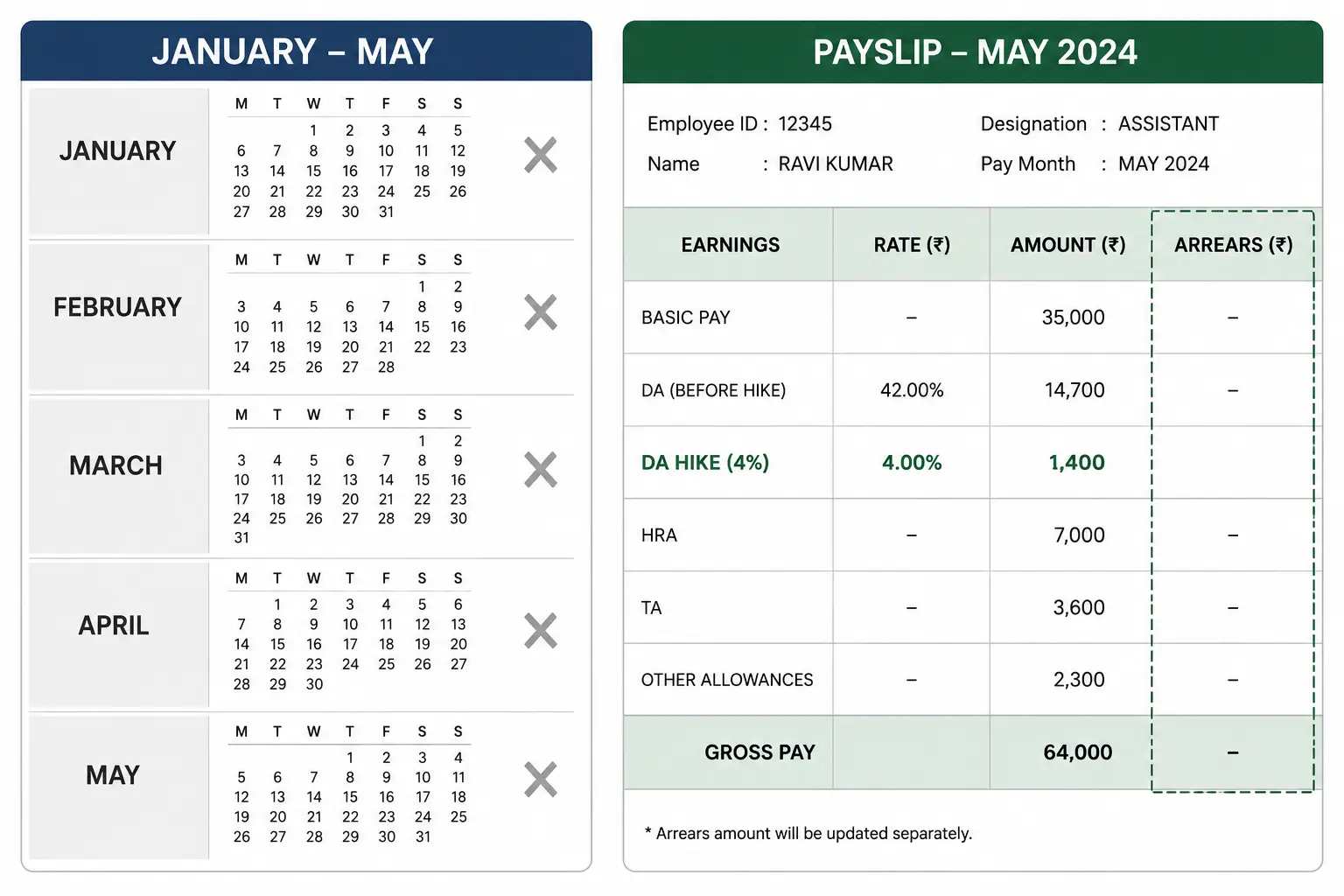
That’s not what happened. The order said the hike takes effect immediately, with no backdating to January 1, which is when the half-yearly DA cycle actually started. My organisation followed the same line. For me, that worked out to roughly 4,000 rupees gone, money I had already mentally set aside for my child’s monthly tuition fee.
I won’t pretend I took it well. My first reaction was anger, and honestly, a sense of being cheated. Not because the hike itself was wrong, DA going up is a good thing, but because the five months between January and May simply vanished from the calculation, as if they never happened.
Why Other States Backdated Theirs to January and Yours Didn’t
The Centre set the pattern. The Union Cabinet cleared a 2% DA hike on April 18, 2026, raising it from 58% to 60% of basic pay, with effect from January 1, 2026. The formal order followed four days later, and three months of arrears, January to March, were credited along with the April salary itself.
States picked it up through May. Odisha, Tamil Nadu, Bihar, Uttar Pradesh and Arunachal Pradesh all matched the 2% hike and backdated it to January 1. Most credited the pending arrears in cash along with the May salary; Uttar Pradesh routed its four months of arrears into employees’ GPF accounts instead of paying cash. Bihar also tiered the hike by pay commission, since staff on the 6th and 5th CPC needed bigger jumps to stay in line with 7th CPC employees.
Assam moved last, in the first week of June, close to two months after the Centre and a few weeks after most other states had already settled theirs. The order gave the hike immediate effect instead of backdating it, which meant the January to May gap, five months, simply never got paid. I haven’t found anything in the order itself that explains why, but the pattern is hard to miss: every state that acted close to January 1 backdated without much fuss, and the one that acted last, when the arrear bill would have been biggest, didn’t.
That’s the actual lesson here. Backdating to January 1 isn’t a rule with teeth behind it. It’s a practice almost every state happened to follow this cycle, which made it feel guaranteed right up until one state didn’t.
“No Arrears” Isn’t a Mistake or Temporary: It’s a Decision
My colleagues are still hopeful. So am I, if I’m honest. Part of that hope comes from watching how the rest of the cycle played out: the Centre paid its arrears, most states paid theirs, so why wouldn’t ours eventually catch up too?
Because there’s no rule that says it has to. DA revision dates are set by whoever approves the order, not by a standing law that guarantees backdating to January 1. The half-yearly cycle is real, AICPI numbers do get worked out every six months, but whether arrears get paid for the gap is a separate administrative call each time, not an automatic consequence.
This isn’t even unprecedented. In 2020, the DPE froze additional DA instalments for PSU executives and non-unionised supervisors for nine months, citing COVID, and stated in writing that no arrears would be paid for that freeze period. Different reason, same principle: a government department can decide, on paper, that a gap in DA payment will simply not be backfilled.
So when I say “no arrears,” I don’t mean a clerical error someone will eventually fix. I mean a decision, made the same way Odisha’s decision to backdate was a decision. One went in employees’ favour. This one didn’t.
The Real Cost of Treating a Declared Hike as Money Already in Hand
I’d already mentally booked it. The day the DA hike was announced, I treated the extra two percent as money sitting in my account, even though nothing had actually moved yet. That two percent, on my basic pay, came to roughly 4,000 rupees a month, and I’d already pointed it at my child’s tuition fee for the months ahead.
That’s the actual mistake, and it’s worth being honest about it instead of just blaming the order. A government announcement is not a credited amount. Between a cabinet decision and money showing up in your account, there’s a notification, an implementation date, and sometimes, like this time, a decision on arrears that goes the other way. I skipped straight from announcement to spending plan, and the five-month gap I didn’t expect is what showed up as that ₹4,000 shortfall.
It’s a small number against a monthly salary, but it landed exactly where I’d already committed it, the tuition payment. That’s the real cost of a declared hike: not the rupee figure itself, but the plan you build around money that hasn’t actually arrived yet.
What Colleagues Are Doing Right Now, and Why Hope Isn’t a Strategy
Walk around any payroll desk right now and you’ll hear the same thing: it’ll come, give it time. Colleagues point to how Odisha, Tamil Nadu and Bihar eventually paid their arrears, as if that proves ours is delayed rather than denied. A few think the next half-yearly revision might quietly fold the missing months back in.
I understand the instinct. I felt it the day I found out, and some part of me still does. But hope isn’t something you can budget around, and it doesn’t undo a decision that’s already been notified in writing.
There’s a useful comparison here. When the DPE froze DA for PSU executives in 2020, two employee associations formally wrote to the government calling the freeze unreasonable and asking for a rollback. As far as the public record shows, the freeze stood anyway, no arrears for that period, regardless of the protest. Formal pushback through an association is still worth doing, more on that next, but it’s not a guarantee, and silently waiting guarantees even less.
What to Actually Do If Your DA Hike Comes Without Arrears
Three things actually matter here, not the hope.
First, check the order, not the hallway talk. Read whatever circular or notification your organisation issued for this DA revision, not just the headline percentage. It will state the effective date and whether arrears are excluded; if it doesn’t say either clearly, ask your HR or accounts section directly, in writing, so there’s a record of the question.
Second, raise it through your association if you want it pursued. A formal letter carries more weight than individual complaints, and it’s the same channel PSU executives used in 2020, even though it didn’t reverse that outcome. Still worth doing, because the next time a government revises rates, today’s record of having raised it is what gets cited.
Third, and this is the one I got wrong: stop spending against an announcement. Treat a DA hike as real money only from the month it actually shows up in your payslip, not from the day it’s declared. If you’ve already committed that amount somewhere, the tuition fee, an EMI, a recurring SIP, undo that commitment until the credit actually lands.
I’m not getting my five months back. I’m making sure the next declared hike doesn’t cost me a sixth.