The Circular That Made Me Check What APDCL Was Doing Differently
A circular landed in one of my WhatsApp groups a few weeks back. Nothing dramatic, just a forwarded image of an internal APDCL notice. It showed something that made me stop scrolling: APDCL had already implemented the DA hike with effect from 1st January 2026, arrears included.
That stopped me, because my organisation hadn’t moved on this DA at all. Same hike, same percentage point increase everyone in the PSU circuit was talking about, and one company had quietly settled it months before mine had even raised the question internally.
The natural assumption, and the one most people around me jumped to first, was that our management was simply sitting on it. Negligence, delay, take your pick. I wasn’t so sure. If APDCL and my organisation are both PSUs in the same state, drawing on the same government circulars, why would one move and the other not even acknowledge it had to?
That question is what sent me digging into how PSU pay actually works, and the answer turned out to be more complicated than “someone forgot to act.”
Why Central PSUs and State PSUs Don’t Run on the Same Rulebook
The assumption I’d been carrying around without ever testing it: PSU is PSU. One sector, one set of rules, just different companies wearing the same uniform. That assumption falls apart the moment you actually look at who decides pay for which PSU.
Central PSUs, the ONGCs, IOCLs, BPCLs, Coal Indias of the system, fall under the Department of Public Enterprises (DPE), which sits inside the Ministry of Finance. DPE is the one body that sets the broad pay pattern for every CPSE, board-level and executive pay revised through a Pay Revision Committee roughly once a decade. Even there, DPE leaves room: executive perks can be structured anywhere up to a ceiling of roughly 35–50% of basic, and where in that band a company lands is its own call.
For workmen and non-executive staff, pay isn’t set centrally at all, it’s negotiated company by company through bipartite wage settlements between each PSU’s own management and its recognised unions. That’s why two oil sector PSUs sitting under the same DPE umbrella, say ONGC and OIL India, can still end up with different basic-to-allowance splits. Same regulator, same broad framework, different negotiated outcomes.
State PSUs don’t have a DPE. There’s no central body that performs that role for state-level undertakings anywhere in the country. Each state government decides for its own companies, and the model isn’t even consistent within a single state.
Some state PSUs get folded directly into the state’s own civil service pay system, basic pay, grade pay, the works, run on the same Pay Matrix as a government department. Others, usually the more commercial or manufacturing-style undertakings, get their own board-approved scale instead, closer to how a CPSE negotiates with its unions.
So when a circular about a DA hike goes out, the honest answer to “does this apply to my PSU” depends entirely on which of these two models your specific PSU happens to run on, and that isn’t something printed on your payslip. It’s exactly the gap that put APDCL and my organisation on two different timelines for the same hike.
Two DA Clocks: What the Centre Approved vs What Assam Approved
Once I understood that Central and State PSUs answer to different bosses, the next question was obvious. Which DA hike was APDCL actually following, and was it even the same one my organisation was supposed to be following?
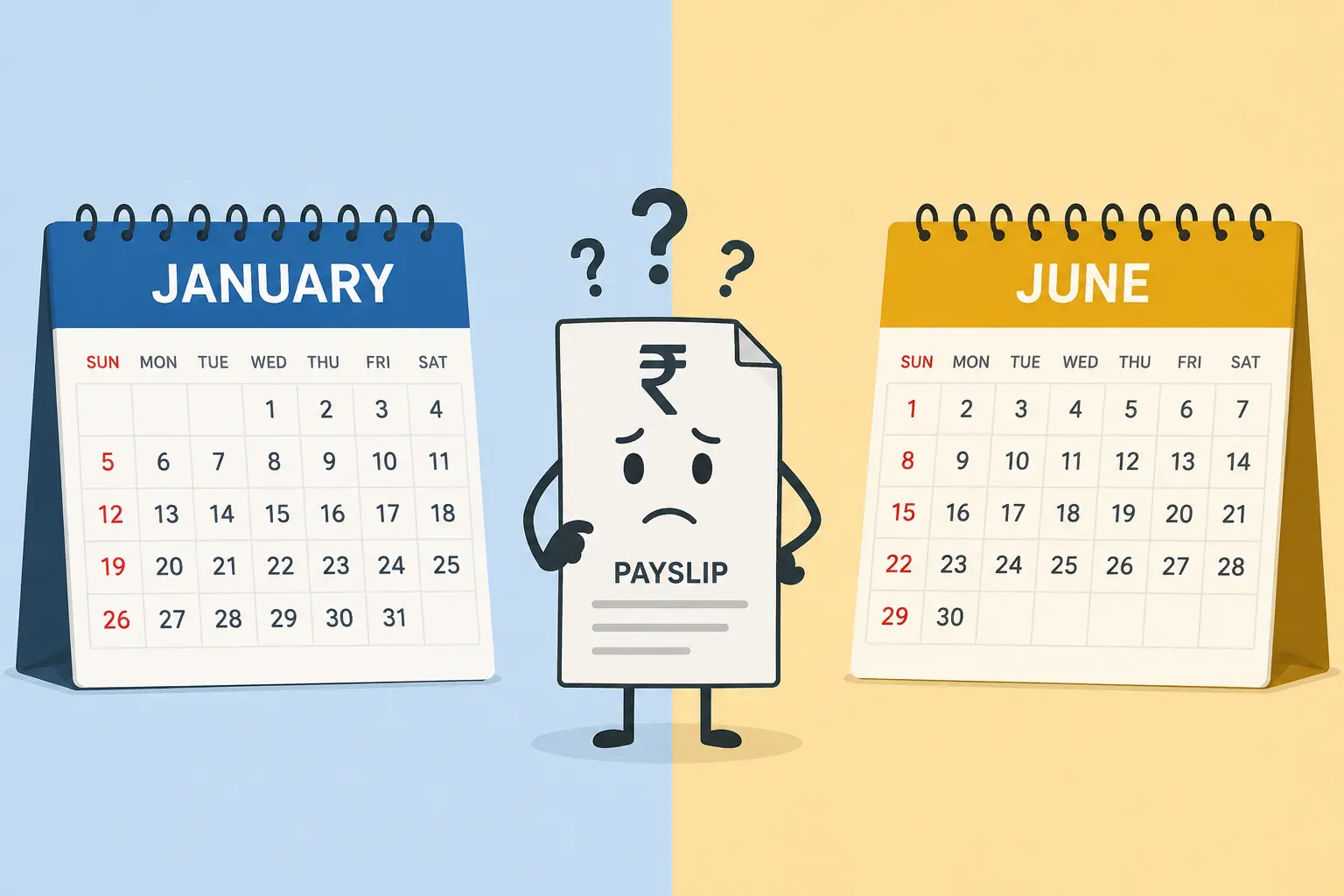
Turns out there are two separate decisions sitting on the table, both raising DA from 58% to 60%, both for the same 2 percentage points, and both completely unrelated to each other in timing. The Union Cabinet approved the Central Government’s hike effective from 1st January 2026, arrears included, formalised through Department of Expenditure and DoPPW orders earlier this year. That’s the Centre’s clock, and it started ticking on day one of 2026. It’s not a small adjustment either, the combined cost works out to roughly Rs 6,791 crore a year, covering close to 50 lakh Central Government employees and 68 lakh pensioners.
Assam’s own hike for its state government employees is a separate decision. The state Cabinet cleared it only in early June 2026, and the Finance Department’s order made it effective “with immediate effect” from mid-June, not from January. It shows up first in the June salary, paid out in July, and covers upward of 8 lakh state employees and pensioners.
There’s no January arrears built into that order. In fact, the state employees’ own union was still publicly pushing the government to backdate it to January, which only confirms the actual order never did.
So a PSU employee in Assam isn’t choosing between “DA hike” and “no DA hike.” They’re choosing between two different valid clocks, the Centre’s January start or the state’s June start, and nothing in most circulars tells you which one your specific PSU is supposed to be reading off.
How APDCL Got Ahead of Its Own State Government and the Risk Behind It
Here’s the part that doesn’t fit neatly. APDCL runs on the Assam government’s own Pay Matrix and Grade Pay system, the same architecture as a state civil servant, not the DPE-IDA pattern that Central PSUs follow. If APDCL is wired into the state’s structure that closely, the obvious expectation is that it would also move on the state’s own DA timeline.
It didn’t. It moved on the Centre’s.
That circular I saw put APDCL’s DA effective from 1st January 2026, with arrears, the exact date the Union Cabinet approved for Central Government employees. Not the mid-June date Assam’s own Finance Department set for its own state employees. So a PSU that’s structurally part of the state system chose, on its own board’s call as far as anyone can tell, to follow a different government’s clock entirely for this particular hike.
I want to be honest about what this is and isn’t. It isn’t proof that APDCL did the smart or correct thing. A board deciding to back-date arrears ahead of any explicit state order saying PSUs should do so is a real exposure, not a free win.
If the state government later clarifies that undertakings were only ever meant to follow the same June 2026 date as state employees, APDCL’s board has already paid out six months of arrears it may have to justify, or in the worst case, claw back. Nobody hands out arrears for free if it turns out they weren’t due.
So the right read of APDCL isn’t “they got it right, why hasn’t yours.” It’s “they took a unilateral bet, and we don’t yet know if it pays off.” That’s a meaningfully different story than the one most of my colleagues assumed when this circular first did the rounds.
A “Vague” Circular Is a Real Administrative Problem, Not an Excuse
When the union raised this with the MD, the response wasn’t a flat no, and it wasn’t a flat yes either. He said the state circular doesn’t clarify what PSUs are supposed to follow. He wanted to take it to the board before committing either way. My first reaction, like most people’s, was that this sounded like management buying time.
It isn’t, once you look at what the MD is actually being asked to decide without any guidance. There’s no DPE-style body telling state PSUs which clock applies to them. The state’s own order is written for state government employees, full stop, it doesn’t mention undertakings or PSUs at all.
So the MD isn’t choosing between “implement” and “don’t implement.” He’s choosing between guessing the Centre’s January date applies, guessing the state’s June date applies, or guessing nothing applies until someone tells him otherwise, and he’s the one who answers for that guess later.
That’s the same bet APDCL’s board already took, just in the opposite direction. APDCL guessed January and moved. Your MD is declining to guess until the board weighs in, which is a slower call but not an unreasonable one given there’s six months of arrears either way that someone has to justify if the guess turns out wrong.
Calling the circular vague isn’t a dodge here. The circular genuinely is vague on this point, and that vagueness is the actual problem, not a cover story for one. The fix isn’t a more decisive MD. It’s a state government that names PSUs explicitly when it issues these orders, so individual boards stop having to bet on it.
What to Actually Do If Your PSU Is Stuck on This
If you’re in this exact spot right now, ambiguous circular, board meeting pending, colleagues assuming negligence, there are two passive options sitting in front of you and neither one actually solves anything. Wait for the board, or quietly copy whatever APDCL did. Both are guesses dressed up as decisions.
Waiting for the board doesn’t bring new information into the room. Your MD is working with the same vague circular everyone else has already read. A meeting doesn’t resolve ambiguity, it just delays who has to act on it. And copying APDCL isn’t safe either, since APDCL’s own board took an unverified bet on the Centre’s date applying to them, and that bet hasn’t been tested by the state government yet.
The actual move is to get a written reference from the state Finance Department, or whichever department administers your PSU, asking one direct question: does this DA order extend to PSU and Undertaking employees, and if so, from what effective date. Push your union to send this in writing, not as an informal query but as something that gets a documented reply. That’s the one piece of information your MD and board are missing too, so getting it first doesn’t go around the board, it hands the board exactly what it needs to make a defensible call instead of a guess.
While that request is in motion, keep your own paperwork in order too. Save the circular, note the date you first raised it with the union, and keep the union’s written request on file. If arrears do eventually get sanctioned, you don’t want your claim resting on someone’s memory of when this was flagged.
Don’t let “the circular is vague” become the final answer. It’s the starting point for asking the only people who can actually make it less vague. Six months of arrears is real money either way, and real money is worth a letter, not a guess.