5 Hidden Facts About Employer Funded Group Insurance That PSU Employees Never Find Out
If you are a PSU employee, there is a good chance your organisation is paying the full premium for a group insurance scheme on your behalf right now, and nobody has ever properly explained what that means, what it covers, or what happens to it when you retire. This article is based on what I found out after joining the employee union and spending months investigating every benefit my organisation actually provides to its employees.
The Employer Funded Group Insurance Scheme Nobody Explains at Joining
When I joined my PSU, my appointment letter mentioned it in exactly three words: “life insurance benefit.” No sum assured, no insurer name, no claim process. Just a footnote buried at the bottom of a list of perks.
It was only after I got involved with the employee union and began investigating every benefit my organisation actually provides that I found what those two words meant. There is an employer funded group insurance scheme here covering every permanent employee’s life, with the full premium paid by the organisation every single year.
Nothing is deducted from your salary. Nothing appears on your payslip. There is no opt-in, no form to sign, and no acknowledgement at joining that this cover even exists.
Nobody in HR sits you down and walks you through it. You either stumble onto it the way I did, or you find out the hard way when something happens to a colleague and the family is suddenly asking questions nobody prepared for.
That gap between what is written and what is actually provided is the real story. This is not a hidden trap. It is a hidden benefit, and most PSU employees are sitting on coverage they do not know the size of, do not know the terms of, and would have no idea how to claim if they ever needed to.
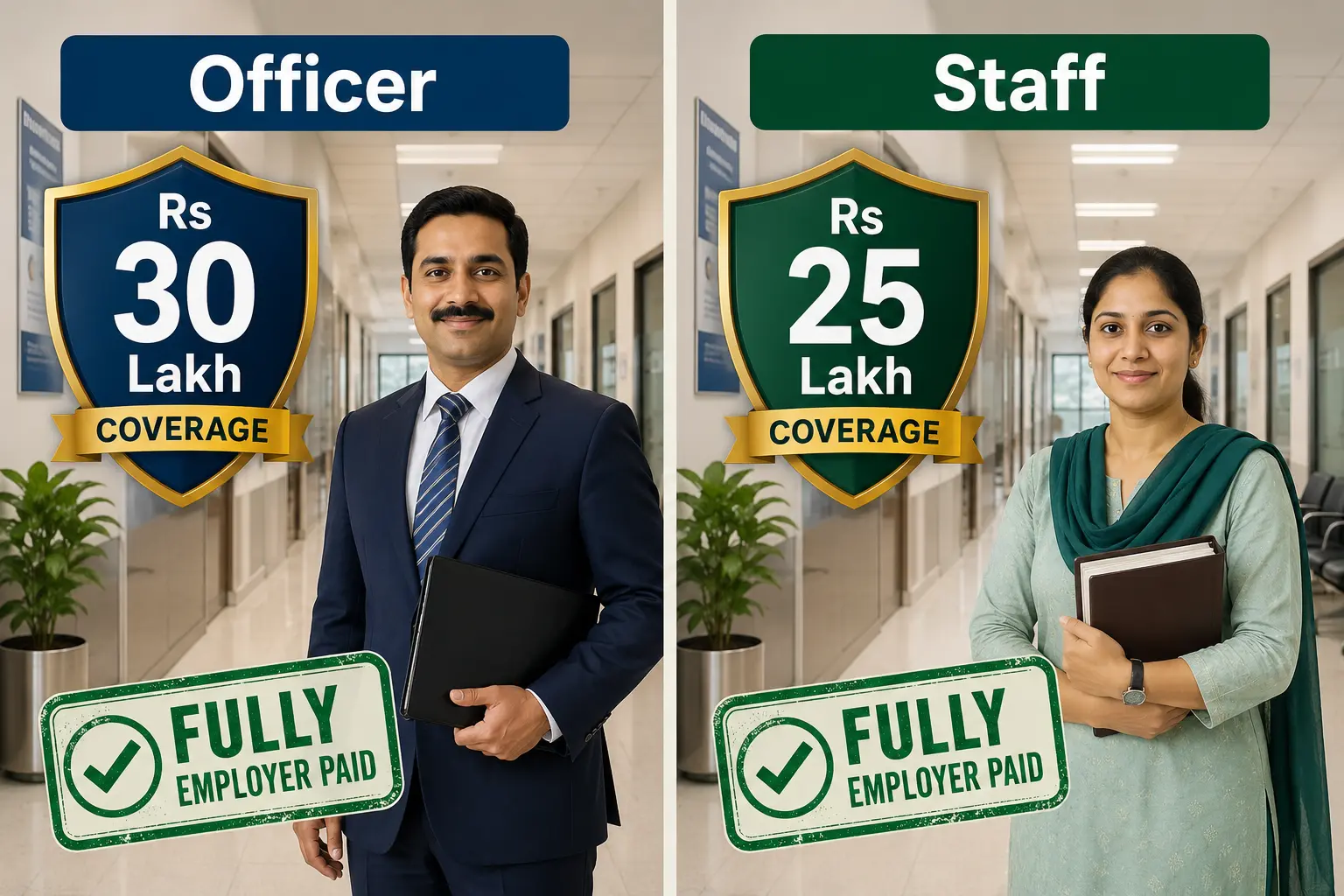
Officer vs Staff: Rs 30 Lakh vs Rs 25 Lakh, Fully Paid by the Organisation
The cover amount is not flat across the organisation. It is split by employment category. Officers are covered for Rs 30 lakh. Staff category employees are covered for Rs 25 lakh.
Either way, the organisation pays the full premium every year. Nothing comes out of your salary, nothing shows up as a deduction, and you will not find a line item for it anywhere on your payslip.
It is structured as a group term life insurance policy, the standard format employers use to cover an entire workforce under one master policy, renewed annually. The category-based split matters because two employees working in the same office can carry very different life cover, and neither one chose that number. It was determined by their grade at the time of employment.
If you do not know which category you fall under for this purpose, confirm it directly with HR or check your service rules. The difference between Rs 25 lakh and Rs 30 lakh is not a minor rounding issue for the family that would actually receive it.
What Your Employer Funded Group Insurance Actually Covers: Death, Disability, and Critical Illness
This is not a plain death-only policy. The employer funded group insurance scheme provides cover under three distinct situations: death of the employee, accidental disability, and critical illness. Most PSU employees assume “life insurance” means one thing. It goes much further than that.
Death cover protects your family financially if you pass away while in service. Accidental disability cover is different. It activates when an accident results in permanent total disability, protecting the employee’s income stream when they can no longer work the same job or any job, depending on the severity.
Critical illness cover pays out a lump sum on diagnosis of a qualifying condition, not on death. This means the employee receives the money while still alive and can use it immediately for treatment costs or to replace income during a recovery period. In standard group insurance products, qualifying conditions typically include cancers, heart attacks, strokes, and major organ failure. The exact list is defined in the policy document.
Three separate financial protections are bundled into one benefit that gets summarised as “life insurance benefit” on a joining footnote. The critical illness component alone can be more practically valuable than the death cover, because the policyholder is alive, needs money immediately, and often cannot work during treatment. Most colleagues I have spoken to in my organisation had no idea this component even existed.
The One Gap Nobody Mentions: Employee-Only Cover, No Dependents
This is the part that catches people off guard. The cover applies only to the employee, not your spouse, not your children, and nobody else in your family.
If you assumed “life insurance benefit” on your appointment letter meant your whole household had some kind of protection, it does not.
This is a structural feature of how employer-paid group term insurance works, not something unique to your organisation. The policy exists to financially protect your family in the event of your death or disability, not to insure your family members’ own lives. The gap is not that the organisation is withholding something extra it should be providing.
It is that most employees never separately ask the obvious follow-up question: what happens if something happens to my spouse, not to me? The answer is nothing from this scheme. Whatever financial impact falls on your household from the death or serious illness of a dependent, this policy does not touch it.
Rs 30 lakh or Rs 25 lakh at zero cost to you is a genuinely strong number. But it is solving for one specific risk, your own life and earning capacity.
Your dependents’ lives are a separate gap that needs to be addressed independently. A term plan for your spouse, or at minimum a family health floater, covers what this group policy cannot and does not replace. If you have dependents and no coverage outside this scheme, address that now rather than when it becomes urgent.
How a Real Claim Actually Played Out: An Anonymized Case From My Organisation
Theory is one thing. Here is what actually happened when this scheme was tested in my organisation.
A colleague passed away. The entire claim process was managed by HR, not the employee’s family. The dependent did not have to chase paperwork, follow up with LIC independently, or figure out the process on their own during an already difficult period. The only document required from the family was the death certificate.
No claim was rejected. The pay-out went through without dispute.
This matters for two reasons. First, the scheme functions when needed, it is not just a line in an appointment letter. Second, HR drives the entire process, not the grieving family.
That is a meaningful structural advantage. In a personal insurance policy, the family would typically need to submit the claim, coordinate directly with the insurer, and follow up independently during the worst possible time. This scheme removes that burden entirely from the family.
One case is not a guarantee that every claim will go this smoothly. Circumstances differ and documentation requirements can vary. But it is a real, confirmed data point from inside my organisation, and a better starting position than the complete silence most PSU employees operate from on this topic.
The practical takeaway is this: employees do not need to brief the family in advance on how to file a claim, because HR handles that process. Telling the family that this cover exists is enough.
The Policy Document You Cannot Access
Here is the part that should bother you more than it probably does. The actual policy document, the one that defines qualifying critical illness conditions, disability thresholds, exclusion clauses, claim documentation requirements, and payout timelines, is not accessible to employees.
It is not posted on any internal portal. It is not distributed at joining. It has never been made available on request through normal channels.
I have never seen it. In the time I spent with the union systematically investigating the full scope of employee benefits, I never received a straight answer on why employees cannot access the policy that covers their own lives.
To be clear: I am not alleging that anyone is deliberately withholding it to deny future claims. The one claim I personally witnessed was settled without dispute. But “we cannot access the document and no one has explained why” is the honest answer, and it is worth stating plainly.
What this means in practice: you are covered by a legal contract you have never read, for conditions you do not fully know, administered by a department that has not explained the fine print to you. The coverage is real. The transparency around it is not.
If you want to know more than the two-word footnote in your appointment letter, ask HR directly and in writing, request the policy schedule or at least the key features document, and do not assume the information will come to you unprompted.
The Retirement Cliff: Why Your Employer Funded Group Insurance Ends the Day You Exit
This is the part that surprises most people, even though it follows logically from everything above. The Rs 30 lakh or Rs 25 lakh cover is tied entirely to your employment status. The day you retire or resign, the cover ends completely, with no continuation option, no conversion to a smaller policy, and no premium refund.
This is not specific to your organisation. It is how employer funded group insurance operates everywhere. The scheme exists to protect your family while the organisation is employing you and paying the premium. Once the employment relationship ends, the premium obligation ends with it, and so does your coverage.
The dangerous part is not the cliff itself, that is a disclosed structural feature of group term products. The dangerous part is the gap it creates in practice. Most people in my organisation have never bought a personal term life insurance policy because the group scheme has silently done the job for free throughout their working years.
Then retirement arrives, the cover disappears overnight, and at that age a fresh personal term policy comes with stricter medical underwriting, higher premiums, and in some cases rejection based on pre-existing conditions that developed during those same working years. The benefit you relied on for three decades without thinking about it becomes a gap you only notice the year it closes.
The fix exists, but it requires action well before retirement, ideally in your 30s or early 40s when term insurance premiums are still low and underwriting is straightforward.
What Every PSU Employee Should Do About These Gaps
This group insurance benefit is genuinely good. Rs 30 lakh or Rs 25 lakh at zero cost to you is not a small number. But knowing the limits of what you have is what actually protects you and your family, not assuming everything is covered.
Here is what is worth doing, based on everything above. First, confirm which category you fall under and what your exact sum assured is, do not assume you know. Second, ask HR in writing what the scheme covers for accidental disability and critical illness, what the qualifying conditions are, and what documentation a claim requires, before you ever need that information in an emergency.
Third, since this group cover does not protect your dependents, evaluate separately whether your spouse or children need independent coverage. Fourth, if you do not have a personal term insurance policy outside this group scheme, get one now while you are younger and healthier, not at retirement age when medical underwriting becomes significantly harder.
I am not a SEBI-registered advisor or a CA, and views expressed are personal. This is based on one organisation’s scheme and one observed claim, not a universal rule applicable across all PSUs or all group insurance products.
Go check your own appointment letter right now. If you see a two-word footnote like “life insurance benefit” and nothing else, that is your cue to ask HR what it actually means before you find out the hard way.